Showing posts with label pediatrics. Show all posts

Friday, December 21, 2018

Pediatric board preparation

Senior recommendations and advice
The predicted breakup for the board questions:
  • Between 60-70% MCQs are from concepts asked in the previous years 
  • Between 20-25% MCQs are questions asking a more difficult concept but from the same topics from previous years
  • About 5-20% of the questions are newer topics/very difficult or impossible questions
Therefore, its almost impossible to pass without doing the previous years questions!!

Application procedure
  • Opens in January or somewhere over there and it is administered over 3 day period in mid-October
  • Prior to sitting and writing it you will NEED a PERMANENT license to take the boards. My sincere advice is to start applying for it early. However, it also depends on where you are practicing/doing the fellowship. Since some states like MA, do not allow a permanent license for IMG's unless you have completed a residency (3 years of training in the States)
  • Do note- You can register for exam w/o license but need proof of it prior to writing the boards
  • Once registered for the exam they will send you an email maybe 2-3 weeks later telling you can schedule your exam. I took my test on Day 2. 
Documents needed for above
By early July
  • Copy of your medical school diploma + English translation, if necessary
  • Copy of ECFMG Certificate or documentation of successful completion of the MCCEE or Fifth Pathway/FMGEMS
By October 1st of the year you are writing
  • Copy of your valid (current), unrestricted medical license 
  • The copy of the lice must include the expiration date and must be issued before October 1st 
  • Please note that temporary or training licenses are NOT acceptable 
The exam itself
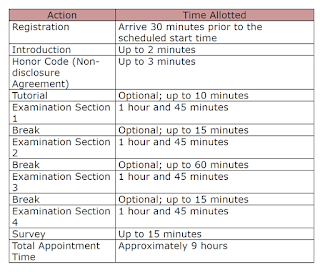
  • Approximately 335 questions divided across 4 sections, with each section having roughly equivalent content, difficulty, and length
  • 4 sections, 84 questions per section, 1 hour 45 minutes/section
  • Most of us finished at least 2 sections with about a half 20-30 min to spare
  • 3 Breaks: OPTIONAL
  • 15 min, 60 min, 15 min
  • Passing score: weighted score of 180, ~75% questions correct.
  • Each exam is different, and some exams are “harder” than others, but are weighted accordingly to give you a scaled score from 0-300

Things that I used for the preparation are as follows

My first year ITE was pretty good. I attribute that to my Step 3 knowledge. However, my 2nd year ITE was not great. Started reading from the Medstudy books system wise and doing questions, system-wise (the video shows how to do it). I even bought the medstudy flash cards. My 3rd year ITE was good and I just kept at what I was doing till then. Towards the end of 3rd year, kept glancing through 'Laughing your way through the Boards'. Recommended by my seniors and attending. Loved it

PediaLink
The following video has tips that I used for studying.

Medstudy
The following video has tips that I used for studying from Medstudy


OneNote

Best of luck.

P.s.- I passed the boards! Yay. I am now a Board Certified Pediatrician.

Wednesday, February 28, 2018

A million moving parts

The following post is by one of my colleagues at work. An amazingly inspiring story to keep persisting when all the odds are against us!

"It is a gamble. There are a million moving parts to matching to Residency and despite everything we do, there are powers beyond us that determine how those million parts fall together. But fall they will, and you will have an answer on the 15th of March. That is the best thing about this whole journey. Closure. I was lucky. Very lucky. I had a lot going against me. I applied for residency at the age of 28, 4 years after I'd graduated from an obscure medical school in China. I had lower end scores, no step 3 and I needed a visa. I matched in my first attempt.

 Here is my story.

It was 2014 and my boyfriend of 5 years and I would spend hours discussing ways of avoiding the inevitable course our futures held, had we stayed in India with our social limitations on just being us. I wanted out. Soon after graduating, I worked with the organization of my dreams-Doctors without borders. 3  years with them allowed me the privilege to serve in the poorest and most dysfunctional parts of India. South Chattisgarh, Eastern Nagaland by the border with Myanmar, Mumbai. I did my time and worked hard. In my last project in Mumbai just as I joined the project, I had 2 colleagues leaving to begin their Residency. This serendipitous moment planted the seed in me to think of the USMLE's. I had never really thought about it prior to that.

30 days later, I quit my job, convinced my parents and boyfriend that this our future and started the journey. I had no idea the rollercoaster ride I had just thrown myself into.  This was the biggest risk I had ever taken. I started off by deciding on a timeline to get things done. My biggest struggle was getting Clinical experience opportunities. Every hospital that offered observerships required step scores or personal recommendations. I got lucky early when I applied to observe under an ID doctor at a  hospital in Florida that accepted me simply based on my personal statement and my past ID experience with MSF.  A lesson for all of you is try to tie your past life experiences into your application. It really helps. My ID observership was a huge success. I was diligent during the month, came in earlier than the residents, left after, attended lectures, helped out the team, reached out to other faculty and got myself on board 6 publications that help me to this day! Another tip for all of you is to try to network with other faculties in the hospital you are doing an observership in. You won't believe the doors that will open  with a simple email to a professor in the hospital(I introduced myself as an observer in the hospital which I was--gave my email a lot more relevance)

My second observership was a disaster. I made a cardinal mistake of doing my observership in a specialty I had no interest in.  I struggled with showing interest in contrast to my previous observership. Lesson number 3- Might be obvious but please do electives in subjects you are interested in - Your passions drive a lot of your juju and people can easily spot when you don't have your heart in it. It's funny because I was in cardiology.  My third observership was at a community hospital in Cleveland that was fortuitous in that it put me on a path that would eventually lead me to Residency. I again used my rule number 1  which is getting in touch with other physicians while I was on this rotation, except that this time I started emailing attendings and contacts outside the hospital. I noticed I had a colleague from my MSF years doing his residency in Cleveland and reached out to him and he connected me to a physician at the Family Medicine clinic of the program I eventually matched into.

This opened a lot of doors. I was able to learn more about the program in an area of medicine I was passionate about and it showed. At the end of the rotation, I got a stellar recommendation and the program very likely factored that in when they ranked me. I interviewed at a couple of other places but my heart had already been set on this program. On March the journey came full circle when I opened the email. I had matched!

In hindsight, I would give the following advice
-Networking matters! Help is found in the most unlikeliest of places. Reach out to other doctors at the hospital to possibly extend rotations
-Do observerships/rotations in a field of medicine you are interested in
-Figure out what your life story is and if you feel it is not extraordinary --make it! There are a million NGO's looking for volunteers, it will give you a nice context to weave your narrative


I wish you all the best and ask you to be hopeful! I matched in the face of a million odds. It is possible. The other side is beautiful.

What if you don't match
-try again a second time. Do rotations that are in programs with residencies
-Think about alternate medical careers-Not the best option if you want to do clinical but Clinical Informatics is a great option-there is an increasing demand for FMG's with a medical background to get involved. Another option is the pharmacy industry. There are always options available if you look closely. You will probably have to do a few months of unpaid work before you get your foot in the system.

Rahul Shenoy